
PART 1: INTRODUCTION
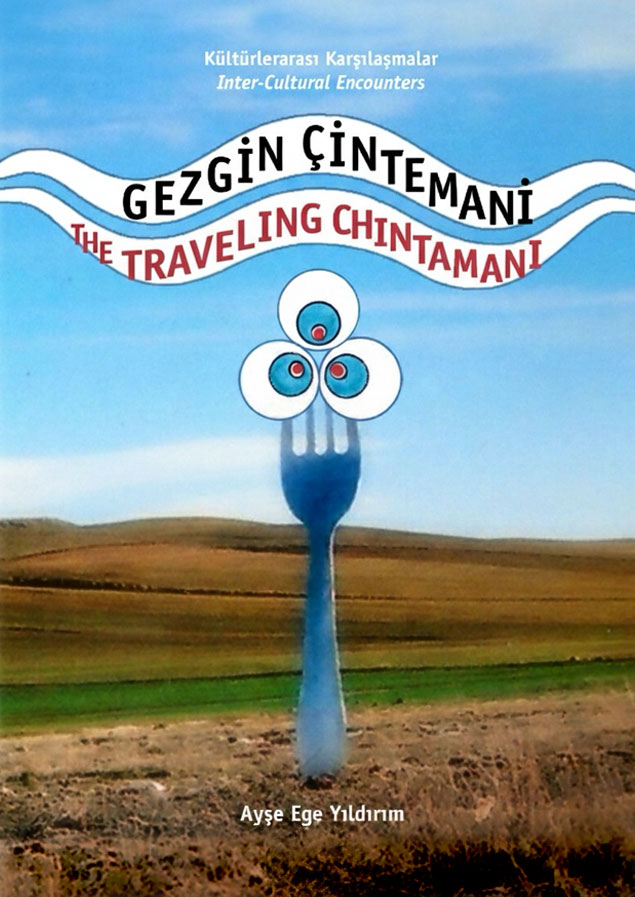
In 2014, shortly after moving from Abu Dhabi to Istanbul, I started a book writing project.
It’s a mix of autobiography and essay genres. I was working on it simultaneously in Turkish and English, having written about 100 pages in each language. But over the past decade or so, both my environment and I changed, and the text got somehow outdated.
I have now started revisiting this project. I decided to update and complete some sections I felt worth sharing. So here I am. Regads from the Traveling Chintamani…
“The Traveler”
They say, “one cannot be explain it, one must experience it,” but one must also write it … Writing, as you know, could be considered a kind of self-therapy, or a way to make sense of situations not possible to make sense of otherwise.
For many years—in other words, for most of my life— I wrote and took notes for myself as I was swept from city to city, country to country, culture to culture and mood to mood.
Sharing is the twin sister of writing. What we really want to do through writing is to confide in someone. That someone is first ourselves, sometimes just ourselves. Then, sometimes, others. Throwing ideas into the world, into space, saying, “Let’s do it, for what it’s worth!”
So that others might enjoy reading, identify with and benefit from what we write. To leave a unique, albeit small, note for the historical record. Or we share out of a desire for others to appreciate and understand us. In today’s digital technology and social media environment, there’s no need to even discuss these things… Despite all the pollution and overdose of information, our ability to share meaningful things remains eternal; we are, after all, human.
I am a big traveler. This stems primarily from my being a diplomat kid. These diplomatic childhood travels later became ones made in adulthood for: graduate studies, living abroad as an ‘expat’ for work, and after relocation home permanently, regular business and social travel. What emerged was an “international Turk.”
In my book endeavor, the Traveling Chintamani, I attempt to talk about the life of one of these diplomat kids (or “third culture kids”), telling the strange and funny stories that come along with it.
I first thought about examining the state of us diplomat kids (or ‘diplobrat’s as some may prefer, if they want to allude to our possibly being spoilt..) as a project during my college years (c.1996). While wondering if there were any Turkish studies on this topic, I learned that the Americans had (of course, if anyone had, they would have been the first to do it!). First, I found a study by the US State Department (on state.gov; the link is obsolete), then the work of an anthropologist (Ruth Hill Useem), and then the web portals created by the 3CKs themselves. (The most concise definition of 3CK is, in Useem’s words: “children who accompany their parents into another society.”) On whether or not the information in these sources would apply to all the ‘international kids’ of the world, I would say not 100 percent, as it would need to be adapted to the local cultural contexts; however, there are bound to be many common characteristics.
If I were to summarize the meaning of this life for me personally, I should first say that, the nuclear family made up of my mother-father-sister and me has been fundamental, in terms of the support and solidarity we received from each other during our childhood and youth, whenever we felt like aliens in all those different, disconnected places. As for the few weeks spent with extended family during the summer holidays, these made it possible for us to maintain ties, however imperfect, with our “homeland”.
Constant or regular traveling and relocation and living in many different places brings an incredible need for mobility on one hand, and fosters the habit and skills of ‘settling in’ and ‘becoming local’ in the places of residence in a short span of time, on the other. You become a chameleon, so to speak. Adapting = surviving… Furthermore, when you realize that every moment that makes up your life is significant and valuable in itself, you have to find a way to enjoy the place you are, rather than wait for the difficult stays to be over.
Flying from branch to branch, resting for a short while on one, flying away again, taking off into far horizons… At times it is a relieving sense of freedom, at other times a feeling of loneliness and disconnectedness that weighs life down. Being a kind of ‘eternal tourist’ and observer.
I suppose this would make us quite fit for a career in the fields of diplomacy, culture and tourism. Our relationship with ‘place’ and ‘the earth’ are constant themes or sub-texts in the fields of architecture, planning, geography and cultural heritage. By looking at places and cultures at a macro level and from an analytical perspective, one may have a chance to alleviate the feeling of being stuck between places and cultures and to channel it into useful activities, to a certain extent at least.
Speaking of looking of things at a macro level, making connections between different events and subjects would also seem an enjoyable and natural pursuit for us mobile types. Perhaps this is why I like being a ‘generalist’. In this book, I explore my own professional field of urban planning and cultural heritage preservation, with interpretations based on personal observation, common sense, and intuition.
“The Chintamani”
So, I think you understand the “traveler” part of the book’s title. As for the ‘Chintamani’ part, I am guessing that many of us would have had a chance to see this symbol, which has long fascinated me, in museums, exhibitions, and souvenir shops dedicated to Ottoman art. As for me, I have grown even fonder of it after I copied its pattern printed on a pillow in my parents’ home and took it to be tattooed on my arm in 2001. Imprinting an artistic motif characteristic of Turkish culture into my own body and carrying it around with me thereafter, seems to have found its meaning as a symbol of the identities etched in our being…
I know a little something about the meaning, and the historical, and cultural significance of the Chintamani pattern from what I’ve read over the years, but now I’ve browsed a few articles again (like Bulut 2018, iznikmavicini.com, Paralı and Mangır 2024, Wikipedia/cintamani), and then asked ChatGPT, to give me a summary. (We’ve entered the age of Artificial Intelligence, so why not? Let’s take advantage of it, right?)
“The Chintamani pattern is an ancient motif originating in Central Asia, widespread in Turkish-Islamic art, particularly during the Ottoman period. Its name comes from the Sanskrit word “cintamani” (wishing stone, lucky jewel), and carries meanings such as power, strength, happiness, and protection. The pattern generally consists of three rounded shapes (triple pearls or spots) and two wavy lines (tiger hide or cloud motifs) next to or between them. It was used in Ottoman palace caftans, tiles, book decorations, and textiles from the 15th century onward.” It became a symbol of sovereignty, symbolizing the sultan’s power, wisdom, and justice. Because it reflects both cosmic powers and worldly authority, the Chintamani motif is also considered a “symbol of Ottoman power. “”
It feels very good for me to embrace as an identity, the story of Chintamani’s arrival from the East and its Westernization in Anatolia within Turkish art. I, too, am a “Western Easterner”; a Turk and a citizen of the world. I strive to be a nationalist, patriot, committed to my homeland, and socially conscious, while having a free, inclusive nature, belonging both everywhere and nowhere. Let’s define it this way. We are what we define ourselves to be, aren’t we?
PART 2: CITIES, LIVES AND MEMORIES
Chapter 2: City Periods
Geneva, 1975-76 (about 6 months): A word on a passport
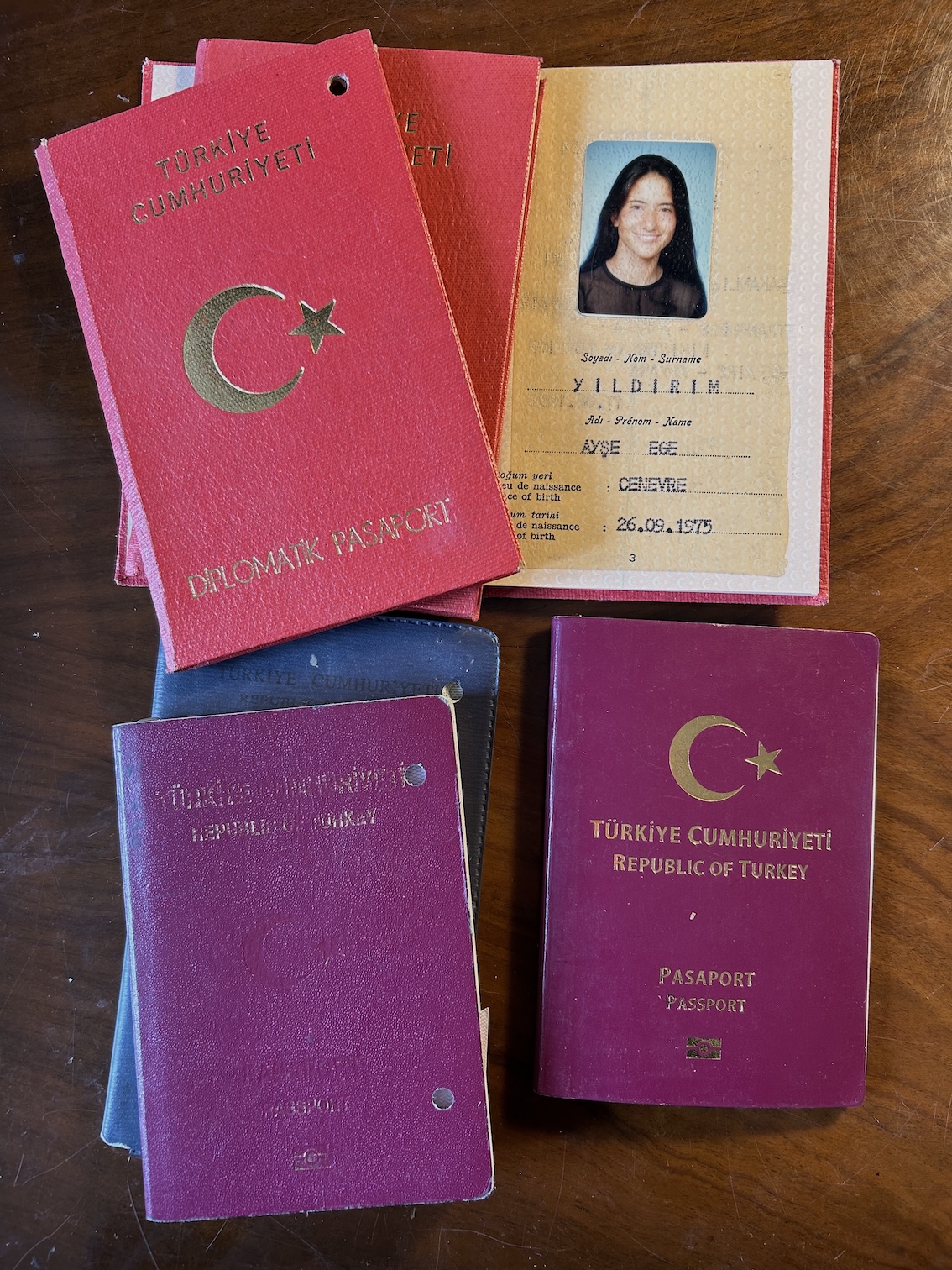
‘Geneva’ is a magical word written in my passport… But this most certainly does not mean that I am a Swiss citizen..! I think life would have been noticeably easier if that were the case. Geneva was my father’s first assignment abroad after he joined the Ministry of Foreign Affairs. We returned home a few months after I was born there.
A small ordeal I went through in 2014 regarding my birthplace was when I tried to sign an online subscription contract on the website of İGDAŞ, the Istanbul Natural Gas Distribution Company. On the registration page, they refused to accept my entry of “GENEVA/SWITZERLAND” as it appears on my ID card. After trying a dozen variations – with and without Turkish characters, spaces, etc. – I couldn’t get past the warning message and finally gave up, realizing I’d have to go to their office in person to complete the subscription process the old-fashioned way. Dear Switzerland, you didn’t grant me citizenship, but thanks to you, I’ deal with this kind of situation with the Turkish Republic bureaucracy!
I visited Geneva again for the first time in 2018, for a business meeting. It was a beautiful and charming city, and I had a good time, but beyond that, I must admit it didn’t mean much to me. I suppose I just have a symbolic and abstract connection to it. In 2023, I applied for a position at an international organization based in Geneva, and during the interview, a conversation came up showing they were curious about my being born in Geneva. (I wasn’t hired for the job!)
Bangkok, 1976-78 (2 years): The cook, his family and me
My father got his second assignment abroad soon after our return to Turkey. As luck would have it, Turkey’s new ambasador in Bangkok was not yet appointed at that time, and my father being the most high-ranking (or possibly the only!) career diplomat in the mission, he needed to be the acting ambassador, or ‘chargé d’affaires’. Thus, we resided in the house with a garden that was the ambassador’s residence.
Apparently I hung out a lot with the cook at the residence compound and his family, and with them I learned the first language I spoke, Thai. To be able to communicate with me, my mother had to learn a little bit of Thai herself! She says ıI understood every word in Turkish that my mother said, but answered her only in Thai. She also wondered why I was usually not so hungry at dinner time, and discovered that I was eating already with the cook and his family. The only image I have in my brain from this period is myself sitting on top of a table in a house (probably the cook’s own kitchen), a dimly-lit room with a lot of laughing faces around me.. They say I ate the spiciest dishes at that time, too spicy for my parents to eat. And that I played with the little snakes in the garden. Again as luck would have it, in the years to follow, there would be no more knowledge of Thai left, nor an inclination toward spicy food, nor a particular love of snakes… If there is something that did remain, it is my love of eating rice, the staple food of Asia.
Ankara, 1978-80 (2 years): Turkish with a Thai accent
The day of our return to Turkey seems to be memorable; never having seen snow before, I reportedly asked “why is there soap foam everywhere?” I probably asked this in Turkish, because from what they tell me, the moment I set foot on Turkish soil, I stopped speaking Thai and started speaking Turkish. That was the end of Thai for me permanently. (Side anecdote: Many years later, in 1994, a Thai friend of mine from German class in Berlin took me out to dinner and taught me a few Thai words, saying I had a great accent, but I think that was as far as a revival would go.. Then In 2015, I had a chance to visit Thailand again for the first time for a conference; this was similarly both nostalgic – in an abstract way – and pretty fruitless in terms of regaining any Thai skills (no surprise there!). Anyway, back to Ankara 1978.) Despite the radical move of adaptation that my subconscious pulled on me, I was at first speaking Turkish with a Thai accent. The sounds ‘ü’ and ‘ö’ not existing in Thai, I pronounced ‘düğme’ (button) as ‘duğme’, and ‘göbek’ (belly) as ‘gobek’. I suppose I asked my first question in Turkey as “neden her yerde sabun kopuğu (not ‘köpüğü’) var?”!
In the meantime, my sister Emine was born! Another one of the very few images left in my mind from this time, is the baby carriage that entered my maternal grandparents’ summer house in Kuşadası in the evening, carrying in it a plump-cheeked, very bald and very smiley baby, which was to me the cutest thing in the whole world- I was captivated! Thus came along the person whom I could easily call the most important friend and lifelong companion I would have. They gave the task of giving Emine’s ‘middle/ secondary name’, or ‘göbek adı’ (or even ‘gobek adı’!) in Turkish, to little old me. I remember my grandfather reading aloud names from the red ‘Dictionary of Names’ in his hand and me getting very enthusiastic when I heard the name ‘Gülçiçek’ (literally meaning Rose Flower). Poor Emine, she was pretty upset with me for many years, for naming her this secondary name that she doesn’t exactly adore (she has later used this in her standup comedy shows; you can imagine the jokes…). I think it would be more appropriate to blame my parents, who were such democrats and liberals that they would allow a 3-and-a-half-year-old child to name her sister…
For a long while, the homes we chose to live in during our stays in Ankara were always in the Kavaklıdere neighborhood of Çankaya district. This time we lived on Mesnevi Street. I was sent to the famous kindergarten Tante Liz, which I believe was also located around there. As the name suggests, this must be a kindergarten founded by a German speaking lady, and to which the foreign kids in Ankara were sent (Sour Times provided me with the answer: Liz Sey was an Austrian lady..(*2)).). But I only remember a Turkish girl named Çisem, who had eaten my apples during snack hour and I wanted them to operate her tummy and take out my apples, as my little brain could imagine!
(*2: https://eksisozluk.com/liz-teyze-cocuk-yuvasi–478131?nr=true&rf=liz%20teyze%20cocuk%20yuvasi)
Tabriz, 1980-81 (1 year): Blackouts, black chadors and snow white
Our third assignment abroad was Tabriz during the Iran-Iraq War. Among the faint memories of that time is my mother having to pull tight the thick, black plastic curtains beside the normal ones in the evening, as there was a compulsory daily blackout. As I was 5 by now, my parents decided to send me to kindergarten, but this attempt proved a big failure (or success??). When we arrived at the school, I saw the girls and boy seated separately and the girls al covered in black from head to toe, which caused me to start wailing in protest. In response to this and to my embarassed parents, the teacher, who had a view of things that still reflected the secular ‘Shah Era’, told them “it is alright, do not force the child”. Althought I do not remember that teacher, I think of her with gratitude. Another memory along the same lines was of walking on the street and passing by a girl with her mother, the girl not more than 3-4 years older than me and wearing a chador, and her beautiful green eyes throwing a look at me filled with fierce disapproval.. I was quite shaken. I think I was sorry for that girl, and thought “I am so glad I am not from here, and I will not have to cover up like that when I am her age”…
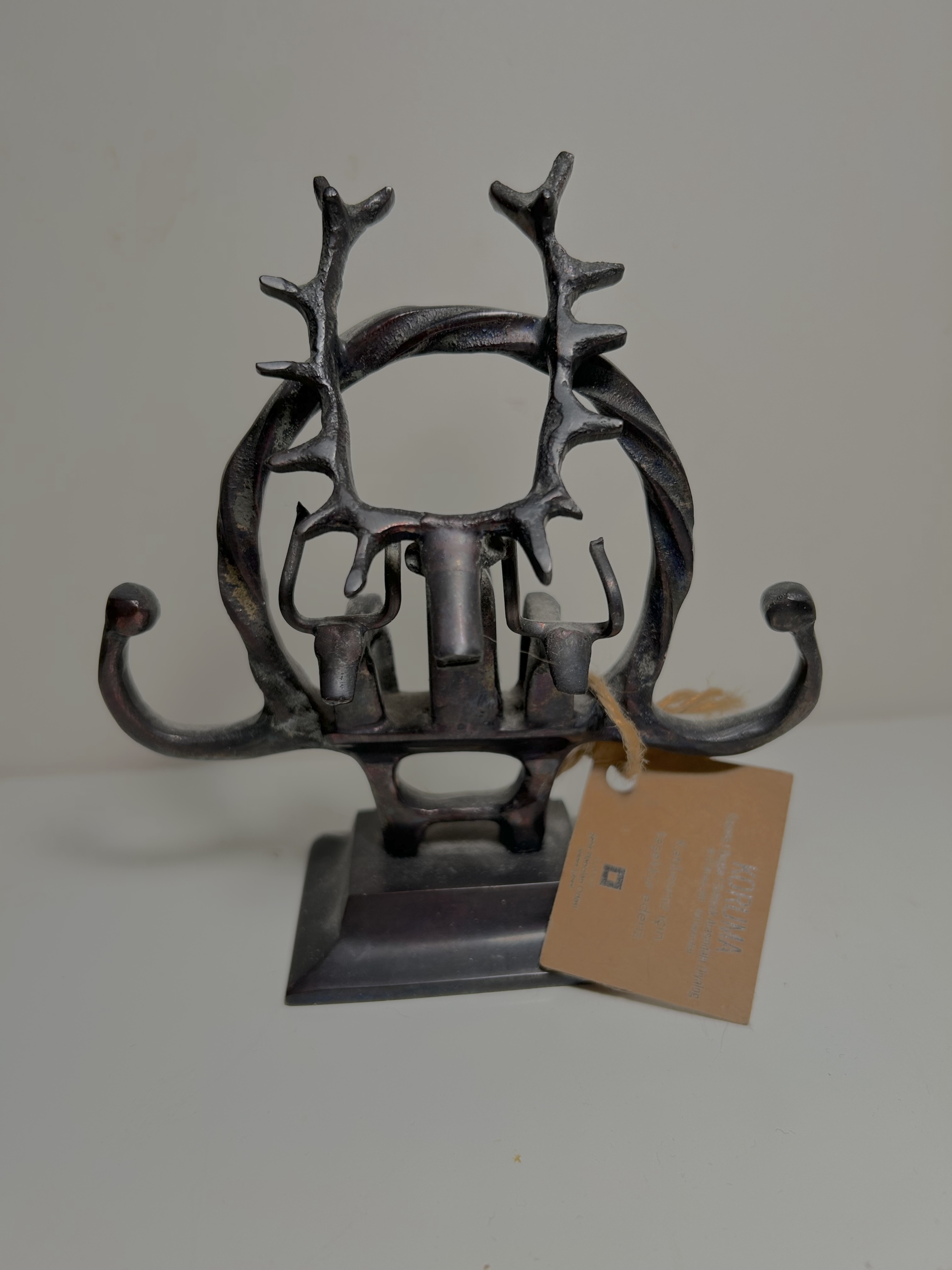
Apart from these, I also remember exits from Tabriz, two car journeys, both times our car (or our convoy of cars) full to the brim with members of two families. The first was a holiday trip to the Caspian Sea, where we were stranded mid-way due to heavy snowfall and had to spend the night in a small town. I remember the sheets of the hotel room bed being very dirty (it might also be my mother’s complaint, which I internalized). The second was our final departure back to Turkey; we passed by Mount Ararat, and its summit was cut off from view by a cloud. When the shape of the mountain, normally expected to be a triangle, became a trapezoid this way, I was left with a feeling of confusion and mistakenness. Later, when we reached the end of that long car trip and my mother woke me up cheerfully in the early morning, heralding the good news that “we arrived in Ankara!!”, I remember looking up and seeing the gigantic statue of a deer (the Hittite Stag God and Sun Disk in Sıhhiye Square). I always liked the fact that my first memory of Ankara is that of this ‘Sun Statue’.
Izmir, 1981-82 (1 year): Potato girls and silk worms
This year, due to my parents not being in Turkey, my mother’s parents looked after us in İzmir. It was the year I started school, at the Yusuf Rıza Primary School, with our class teached Belma Deriner. Another one of those magical names for me. I only remember her pitch black, thick and long hair, and her laughing eyes.
When we stood below the gigantic tree in the schoolyard during recess, silkworms would fall over us and sting our skin.
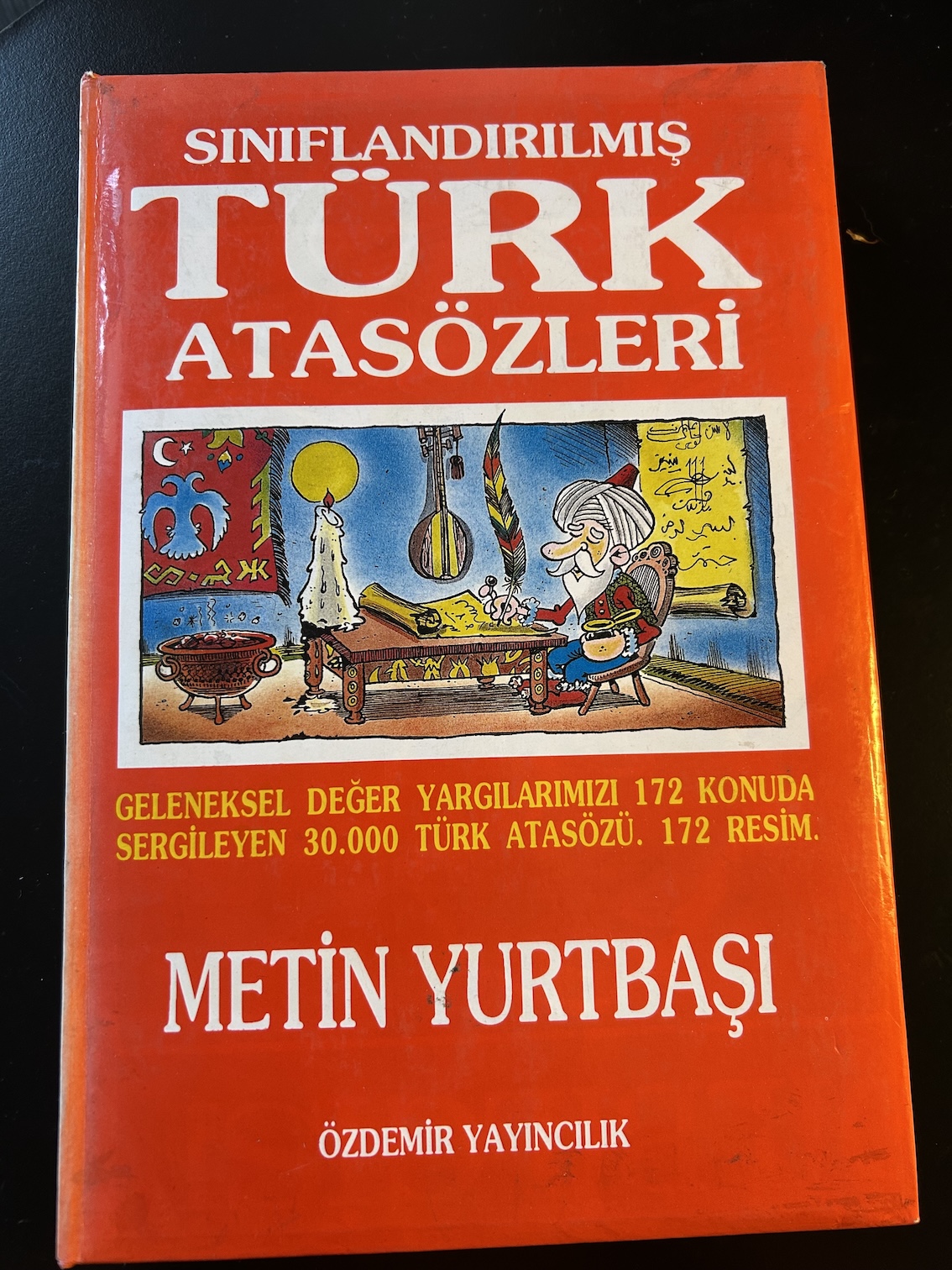
Thanks to this year, I think I got a solid foundation in Turkish reading and writing. I have observed that some diplomat kids who started their school years and continued for some years in foreign schools had trouble mastering written Turkish. I’ve noticed almost all of us, myself included, make funny mistakes with colloquial Turkish, i.e. idioms. So much so that my co-workers in my first real job in Ankara, so many years later, bought me a Dictionary of Turkish Proverbs for my first birthday there, to tease me!
My grandmother contributed remarkably to my education. I suppose she had the advantage of having been a teacher at the Women’s Institute in her younger working days. Beside helping me with homework, she also gave me my first drawing lesson. We used to draw ‘potatoe girls’: a potato for the head, a potato for the body, then for the arms, legs, feet… I remember she even taught us a tiny bit of French, we had repeated the sentence “après la pluie, il fait beau” for instance.. They also sent me to ballet class, in Alsancak near my grandmother (Naciye) and grandfather’s (Kemal) house; at the end-of-year show, we had as one of our props plastic dolls in our arms, and mine had its hair and hat missing, so I was trying to conceal its bald head with my hand, with great distress (!).
Rome, 1982-83 (1 year): Snakes, octopuses and Lady Oscar
If we set aside some beautiful panoramic views of the Eternal City and some posh Italian kids at school, the most important meaning for me of our year in Rome was that it was the first place I learned English. Emine and I were sent to Monti Parioli English School, located in a fancy district of Rome, which I believe was one out of two or three Anglophone schools in the city that my parents found suitable for us. I learned the fundamentals of ‘British English’ from Miss Hulme, our sweet-natured second grade teacher. I remember my very first day at school: there were pictures of animals, plants, etc. on the classroom wall, lined up alphabetically according to the first letter of their name, and Miss Hulme made me repeat after her the names of a random selection of these, thus throwing me head first into the world of English. The only one I remember out of those words I repeated was ‘octopus’.
I believe this school was a Catholic establishment, and every lunchtime, when we sat down at the long tables of the school canteen, everyone would bring their palms together and say their prayers. A short while into the school year, one evening at home, my parents found me starting to do the same at dinner time. Naturally, they were flabbergasted and immediately set out to interrogate me on this strange behavior, telling me that we were not Christian but Muslim, and that was not how we prayed. Thus, I received my second ‘religion lesson’ in life, after my paternal grandmother’s efforts to raise me as a ‘good Muslim’ through teaching me a couple of prayers in Arabic and undoing my left-handedness (these efforts were mainly in vain, particularly the latter..) More precisely, I should say they taught me why and how Muslims prayed in a different manner from Christians. Now, what was I expected to do with this information? To apply it, of course! In other words, go to Monti Parioli and pray like a Muslim in the middle of dozens of children who are praying like Christians, what’s there to it? (!) So began work on this daunting task that would take me just about the entire year to accomplish. Every day, my hands, which were initially closed palm-to-palm ‘alla cristiana’, would open up like a butterfly by a few millimeters, and finally, at lunch time one day toward the end of the school year, one could find yours truly participating in the praying ceremony with my palms completely facing the sky. A few kids around me gave me with a quizzical look, but I ignored them. I suppose I had been preparing psychologically for this moment all year long!..
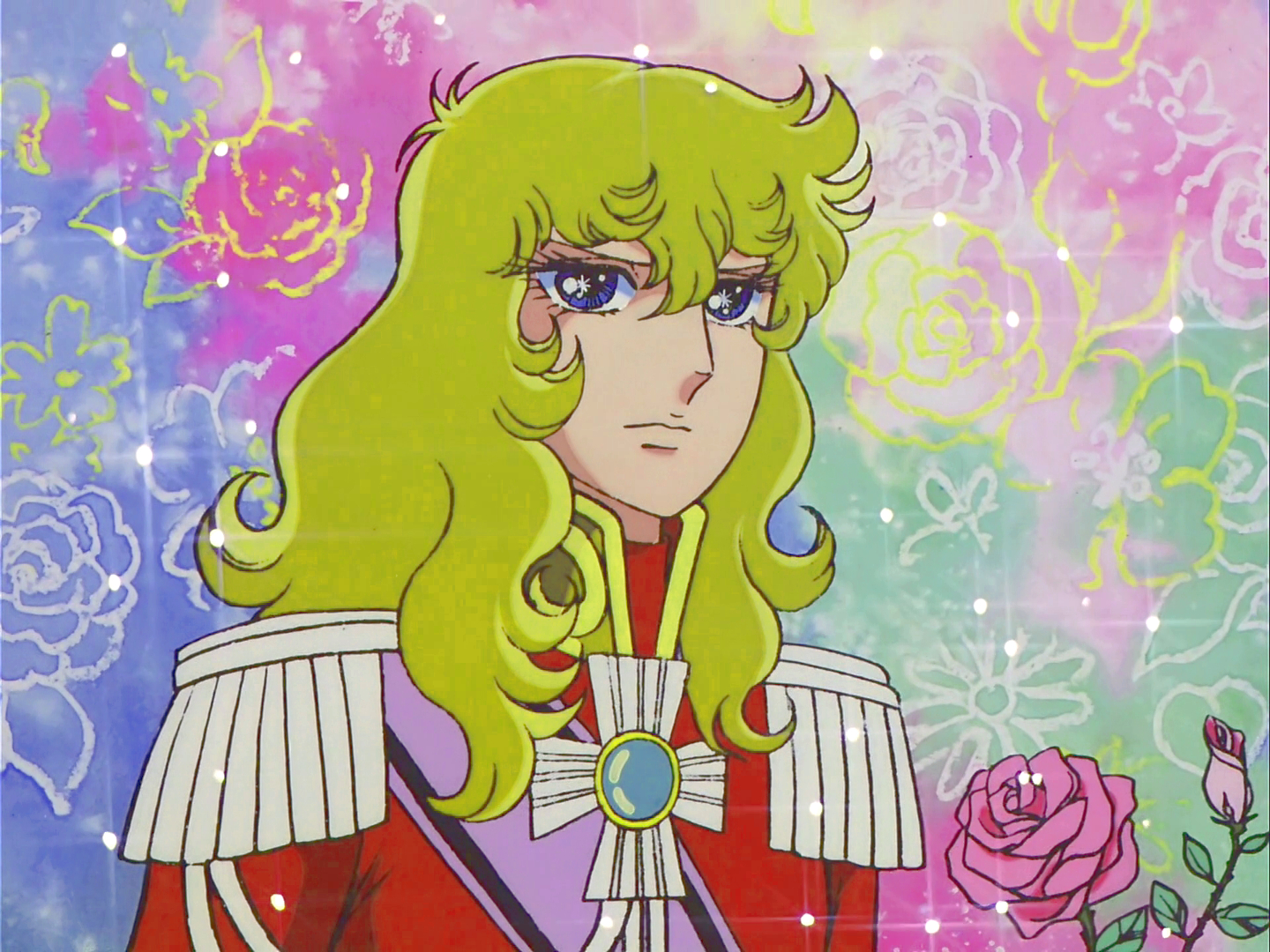
Another subject of dinnertime conversations at home was the negotiation Emine and I would enter into with our father, as our favorite cartoon series, the famous Lady Oscar, would start at 8 pm, the same time as the news that my father wanted to watch on the single television we had at home. He would generally get his way, but sometimes, when we insisted enough, we would get to meet our beloved Lady Oscar, too. Of course, with the technological facilities of that time, we could not really expect much more than that.
I had mentioned that our school was located in a fancy district and full of posh Italian kids. One of the rich families of these kids, that of my classmate Giorgio Bulgari, once threw a costume party at their residence, and I went in my Turkish village girl costume (which must have been the costume left from our folk dancing activities at the school in İzmir, consisting of a ‘şalvar’ [traditional baggy trousers], ‘tülbent’ [muslin headscarf], embroidered velved vest, and a red carnation behind my ear, etc), which was a big sensation! Many many years later, my friend Yonca Moralı (also a diplomat kid whom I had met in Rome 1982, coincidentally) and I had to share a cab in London with a guy who turned out to be an Italian named Maurizio and a good friend of Giorgio’s from college, and of course were quite amazed at this ‘small-world coincidence’. There were other such parties at these kids’ Roman houses, such as at the endless gardens of the villa where Alessandra, a girl from class, lived, and the party at Giaccomo’s place, where I could not take part in some game the kids played in Italian as I could not really speak it and so the parents left me in peace to draw pictures in a room, which I was quite happy to do.
I remember my ‘first love’ (!) Giuliano, who was in my class at the school in Rome, whom I used to give the most nicely decorated glass among the ones on the tray during ‘milk hour’ when it was my turn to serve, and with whom we did innocent things like making sure to sit next to each other in the class photo.. Once, he and his cousin Falco had come to visit our home accompanied by an Italian lady who must have been the mother of one of them, and they brough a beautiful necklace for me as a present. I still have that necklace and after wearing it for many years, made it a decorative object at home. I find the notion of having presents from so long ago one of the amazing surprises life brings..
Another theme among the memories of our Italy year is related to the animal kingdom.. One Sunday, we went to the Safari Park in Rome, the family crammed into our tiny red Fiat, my mother driving.. After various encounters with pink-bottomed baboons, camels washing our side window with their saliva in pursuit of the biscuit we offered and other such creatures, and just as we were approaching the exit gate of the park, wouldn’t our car suddenly break down! We somehow managed to leave the car and walk to the exit without any animal bothering us, leaving the car there, for my mother to deal with its retrieval and repair during the following week.
More traumatizing for me than this, was the incident that I had another time at the zoo, more precisely the minutes I spent in the special enclosed building that was the ‘Snake House’. I had a special curiosity for snakes that must have remained from my Thailand years, and inside the warm, shady interior of the Snake House, I began to visit one by one the aquariums lined along both sides of a long corridor, intently observing the mostly small and colorful snakes lying within them. Some of these snakes were not just lying, but but moving about in their cases; one of them suddenly climbed the front side of its glass clase, as if it were about to leap onto me. In an agitated effort to distance myself from that aquarium, I found myself up against the aquarium on the other side, also jumping back from the snake in that one, but I was surrounded on all sides by cases with snakes in them. I barely managed to throw myself toward the end of that dark corridor and the building exit, running as fast as I could. That das was the beginning of a snake phobia that would last quite a long while!
All in all, our year in Italy left a very sweet impression on me. I could say that the Italian visual esthetics and lifestyle have provided images that set the standards of ‘dolce vita’ and ‘elegance’ in my life. I suppose my mother also appreciated this culture of esthetics, as she bought and wore many pairs of those famous Italian shoes. I clearly remember how she dragged me along one of her shopping sprees across town one hot day, from one shop with a sale to another, and how my pleas to her to give breaks and finish soon were pretty much in vain.
Another souvenir from those years that is still around are the Anna Oxa cassettes. This famous singer, whom I later learned had a somewhat complicated family background, has lyrical songs taht are very close to our hearts and I for one still listen to, such as “un’emozione da poco”…
PART 1: INTRODUCTION
In 2014, shortly after moving from Abu Dhabi to Istanbul, I started a book writing project.
It’s a mix of autobiography and essay genres. I was working on it simultaneously in Turkish and English, having written about 100 pages in each language. But over the past decade or so, both my environment and I changed, and the text got somehow outdated.
I have now started revisiting this project. I decided to update and complete some sections I felt worth sharing. So here I am. Regads from the Traveling Chintamani…
“The Traveler”
They say, “one cannot be explain it, one must experience it,” but one must also write it … Writing, as you know, could be considered a kind of self-therapy, or a way to make sense of situations not possible to make sense of otherwise.
For many years—in other words, for most of my life— I wrote and took notes for myself as I was swept from city to city, country to country, culture to culture and mood to mood.
Sharing is the twin sister of writing. What we really want to do through writing is to confide in someone. That someone is first ourselves, sometimes just ourselves. Then, sometimes, others. Throwing ideas into the world, into space, saying, “Let’s do it, for what it’s worth!”
So that others might enjoy reading, identify with and benefit from what we write. To leave a unique, albeit small, note for the historical record. Or we share out of a desire for others to appreciate and understand us. In today’s digital technology and social media environment, there’s no need to even discuss these things… Despite all the pollution and overdose of information, our ability to share meaningful things remains eternal; we are, after all, human.
I am a big traveler. This stems primarily from my being a diplomat kid. These diplomatic childhood travels later became ones made in adulthood for: graduate studies, living abroad as an ‘expat’ for work, and after relocation home permanently, regular business and social travel. What emerged was an “international Turk.”
In my book endeavor, the Traveling Chintamani, I attempt to talk about the life of one of these diplomat kids (or “third culture kids”), telling the strange and funny stories that come along with it.
I first thought about examining the state of us diplomat kids (or ‘diplobrat’s as some may prefer, if they want to allude to our possibly being spoilt..) as a project during my college years (c.1996). While wondering if there were any Turkish studies on this topic, I learned that the Americans had (of course, if anyone had, they would have been the first to do it!). First, I found a study by the US State Department (on state.gov; the link is obsolete), then the work of an anthropologist (Ruth Hill Useem), and then the web portals created by the 3CKs themselves. (The most concise definition of 3CK is, in Useem’s words: “children who accompany their parents into another society.”) On whether or not the information in these sources would apply to all the ‘international kids’ of the world, I would say not 100 percent, as it would need to be adapted to the local cultural contexts; however, there are bound to be many common characteristics.
If I were to summarize the meaning of this life for me personally, I should first say that, the nuclear family made up of my mother-father-sister and me has been fundamental, in terms of the support and solidarity we received from each other during our childhood and youth, whenever we felt like aliens in all those different, disconnected places. As for the few weeks spent with extended family during the summer holidays, these made it possible for us to maintain ties, however imperfect, with our “homeland”.
Constant or regular traveling and relocation and living in many different places brings an incredible need for mobility on one hand, and fosters the habit and skills of ‘settling in’ and ‘becoming local’ in the places of residence in a short span of time, on the other. You become a chameleon, so to speak. Adapting = surviving… Furthermore, when you realize that every moment that makes up your life is significant and valuable in itself, you have to find a way to enjoy the place you are, rather than wait for the difficult stays to be over.
Flying from branch to branch, resting for a short while on one, flying away again, taking off into far horizons… At times it is a relieving sense of freedom, at other times a feeling of loneliness and disconnectedness that weighs life down. Being a kind of ‘eternal tourist’ and observer.
I suppose this would make us quite fit for a career in the fields of diplomacy, culture and tourism. Our relationship with ‘place’ and ‘the earth’ are constant themes or sub-texts in the fields of architecture, planning, geography and cultural heritage. By looking at places and cultures at a macro level and from an analytical perspective, one may have a chance to alleviate the feeling of being stuck between places and cultures and to channel it into useful activities, to a certain extent at least.
Speaking of looking of things at a macro level, making connections between different events and subjects would also seem an enjoyable and natural pursuit for us mobile types. Perhaps this is why I like being a ‘generalist’. In this book, I explore my own professional field of urban planning and cultural heritage preservation, with interpretations based on personal observation, common sense, and intuition.
“The Chintamani”
So, I think you understand the “traveler” part of the book’s title. As for the ‘Chintamani’ part, I am guessing that many of us would have had a chance to see this symbol, which has long fascinated me, in museums, exhibitions, and souvenir shops dedicated to Ottoman art. As for me, I have grown even fonder of it after I copied its pattern printed on a pillow in my parents’ home and took it to be tattooed on my arm in 2001. Imprinting an artistic motif characteristic of Turkish culture into my own body and carrying it around with me thereafter, seems to have found its meaning as a symbol of the identities etched in our being…
I know a little something about the meaning, and the historical, and cultural significance of the Chintamani pattern from what I’ve read over the years, but now I’ve browsed a few articles again (like Bulut 2018, iznikmavicini.com, Paralı and Mangır 2024, Wikipedia/cintamani), and then asked ChatGPT, to give me a summary. (We’ve entered the age of Artificial Intelligence, so why not? Let’s take advantage of it, right?)
“The Chintamani pattern is an ancient motif originating in Central Asia, widespread in Turkish-Islamic art, particularly during the Ottoman period. Its name comes from the Sanskrit word “cintamani” (wishing stone, lucky jewel), and carries meanings such as power, strength, happiness, and protection. The pattern generally consists of three rounded shapes (triple pearls or spots) and two wavy lines (tiger hide or cloud motifs) next to or between them. It was used in Ottoman palace caftans, tiles, book decorations, and textiles from the 15th century onward.” It became a symbol of sovereignty, symbolizing the sultan’s power, wisdom, and justice. Because it reflects both cosmic powers and worldly authority, the Chintamani motif is also considered a “symbol of Ottoman power. “”
It feels very good for me to embrace as an identity, the story of Chintamani’s arrival from the East and its Westernization in Anatolia within Turkish art. I, too, am a “Western Easterner”; a Turk and a citizen of the world. I strive to be a nationalist, patriot, committed to my homeland, and socially conscious, while having a free, inclusive nature, belonging both everywhere and nowhere. Let’s define it this way. We are what we define ourselves to be, aren’t we?
PART 2: CITIES, LIVES AND MEMORIES
Chapter 2: City Periods
Geneva, 1975-76 (about 6 months): A word on a passport
‘Geneva’ is a magical word written in my passport… But this most certainly does not mean that I am a Swiss citizen..! I think life would have been noticeably easier if that were the case. Geneva was my father’s first assignment abroad after he joined the Ministry of Foreign Affairs. We returned home a few months after I was born there.
A small ordeal I went through in 2014 regarding my birthplace was when I tried to sign an online subscription contract on the website of İGDAŞ, the Istanbul Natural Gas Distribution Company. On the registration page, they refused to accept my entry of “GENEVA/SWITZERLAND” as it appears on my ID card. After trying a dozen variations – with and without Turkish characters, spaces, etc. – I couldn’t get past the warning message and finally gave up, realizing I’d have to go to their office in person to complete the subscription process the old-fashioned way. Dear Switzerland, you didn’t grant me citizenship, but thanks to you, I’ deal with this kind of situation with the Turkish Republic bureaucracy!
I visited Geneva again for the first time in 2018, for a business meeting. It was a beautiful and charming city, and I had a good time, but beyond that, I must admit it didn’t mean much to me. I suppose I just have a symbolic and abstract connection to it. In 2023, I applied for a position at an international organization based in Geneva, and during the interview, a conversation came up showing they were curious about my being born in Geneva. (I wasn’t hired for the job!)
Bangkok, 1976-78 (2 years): The cook, his family and me
My father got his second assignment abroad soon after our return to Turkey. As luck would have it, Turkey’s new ambasador in Bangkok was not yet appointed at that time, and my father being the most high-ranking (or possibly the only!) career diplomat in the mission, he needed to be the acting ambassador, or ‘chargé d’affaires’. Thus, we resided in the house with a garden that was the ambassador’s residence.
Apparently I hung out a lot with the cook at the residence compound and his family, and with them I learned the first language I spoke, Thai. To be able to communicate with me, my mother had to learn a little bit of Thai herself! She says ıI understood every word in Turkish that my mother said, but answered her only in Thai. She also wondered why I was usually not so hungry at dinner time, and discovered that I was eating already with the cook and his family. The only image I have in my brain from this period is myself sitting on top of a table in a house (probably the cook’s own kitchen), a dimly-lit room with a lot of laughing faces around me.. They say I ate the spiciest dishes at that time, too spicy for my parents to eat. And that I played with the little snakes in the garden. Again as luck would have it, in the years to follow, there would be no more knowledge of Thai left, nor an inclination toward spicy food, nor a particular love of snakes… If there is something that did remain, it is my love of eating rice, the staple food of Asia.
Ankara, 1978-80 (2 years): Turkish with a Thai accent
The day of our return to Turkey seems to be memorable; never having seen snow before, I reportedly asked “why is there soap foam everywhere?” I probably asked this in Turkish, because from what they tell me, the moment I set foot on Turkish soil, I stopped speaking Thai and started speaking Turkish. That was the end of Thai for me permanently. (Side anecdote: Many years later, in 1994, a Thai friend of mine from German class in Berlin took me out to dinner and taught me a few Thai words, saying I had a great accent, but I think that was as far as a revival would go.. Then In 2015, I had a chance to visit Thailand again for the first time for a conference; this was similarly both nostalgic – in an abstract way – and pretty fruitless in terms of regaining any Thai skills (no surprise there!). Anyway, back to Ankara 1978.) Despite the radical move of adaptation that my subconscious pulled on me, I was at first speaking Turkish with a Thai accent. The sounds ‘ü’ and ‘ö’ not existing in Thai, I pronounced ‘düğme’ (button) as ‘duğme’, and ‘göbek’ (belly) as ‘gobek’. I suppose I asked my first question in Turkey as “neden her yerde sabun kopuğu (not ‘köpüğü’) var?”!
In the meantime, my sister Emine was born! Another one of the very few images left in my mind from this time, is the baby carriage that entered my maternal grandparents’ summer house in Kuşadası in the evening, carrying in it a plump-cheeked, very bald and very smiley baby, which was to me the cutest thing in the whole world- I was captivated! Thus came along the person whom I could easily call the most important friend and lifelong companion I would have. They gave the task of giving Emine’s ‘middle/ secondary name’, or ‘göbek adı’ (or even ‘gobek adı’!) in Turkish, to little old me. I remember my grandfather reading aloud names from the red ‘Dictionary of Names’ in his hand and me getting very enthusiastic when I heard the name ‘Gülçiçek’ (literally meaning Rose Flower). Poor Emine, she was pretty upset with me for many years, for naming her this secondary name that she doesn’t exactly adore (she has later used this in her standup comedy shows; you can imagine the jokes…). I think it would be more appropriate to blame my parents, who were such democrats and liberals that they would allow a 3-and-a-half-year-old child to name her sister…
For a long while, the homes we chose to live in during our stays in Ankara were always in the Kavaklıdere neighborhood of Çankaya district. This time we lived on Mesnevi Street. I was sent to the famous kindergarten Tante Liz, which I believe was also located around there. As the name suggests, this must be a kindergarten founded by a German speaking lady, and to which the foreign kids in Ankara were sent (Sour Times provided me with the answer: Liz Sey was an Austrian lady..(*2)).). But I only remember a Turkish girl named Çisem, who had eaten my apples during snack hour and I wanted them to operate her tummy and take out my apples, as my little brain could imagine!
(*2: https://eksisozluk.com/liz-teyze-cocuk-yuvasi–478131?nr=true&rf=liz%20teyze%20cocuk%20yuvasi)
Tabriz, 1980-81 (1 year): Blackouts, black chadors and snow white
Our third assignment abroad was Tabriz during the Iran-Iraq War. Among the faint memories of that time is my mother having to pull tight the thick, black plastic curtains beside the normal ones in the evening, as there was a compulsory daily blackout. As I was 5 by now, my parents decided to send me to kindergarten, but this attempt proved a big failure (or success??). When we arrived at the school, I saw the girls and boy seated separately and the girls al covered in black from head to toe, which caused me to start wailing in protest. In response to this and to my embarassed parents, the teacher, who had a view of things that still reflected the secular ‘Shah Era’, told them “it is alright, do not force the child”. Althought I do not remember that teacher, I think of her with gratitude. Another memory along the same lines was of walking on the street and passing by a girl with her mother, the girl not more than 3-4 years older than me and wearing a chador, and her beautiful green eyes throwing a look at me filled with fierce disapproval.. I was quite shaken. I think I was sorry for that girl, and thought “I am so glad I am not from here, and I will not have to cover up like that when I am her age”…
Apart from these, I also remember exits from Tabriz, two car journeys, both times our car (or our convoy of cars) full to the brim with members of two families. The first was a holiday trip to the Caspian Sea, where we were stranded mid-way due to heavy snowfall and had to spend the night in a small town. I remember the sheets of the hotel room bed being very dirty (it might also be my mother’s complaint, which I internalized). The second was our final departure back to Turkey; we passed by Mount Ararat, and its summit was cut off from view by a cloud. When the shape of the mountain, normally expected to be a triangle, became a trapezoid this way, I was left with a feeling of confusion and mistakenness. Later, when we reached the end of that long car trip and my mother woke me up cheerfully in the early morning, heralding the good news that “we arrived in Ankara!!”, I remember looking up and seeing the gigantic statue of a deer (the Hittite Stag God and Sun Disk in Sıhhiye Square). I always liked the fact that my first memory of Ankara is that of this ‘Sun Statue’.
Izmir, 1981-82 (1 year): Potato girls and silk worms
This year, due to my parents not being in Turkey, my mother’s parents looked after us in İzmir. It was the year I started school, at the Yusuf Rıza Primary School, with our class teached Belma Deriner. Another one of those magical names for me. I only remember her pitch black, thick and long hair, and her laughing eyes.
When we stood below the gigantic tree in the schoolyard during recess, silkworms would fall over us and sting our skin.
Thanks to this year, I think I got a solid foundation in Turkish reading and writing. I have observed that some diplomat kids who started their school years and continued for some years in foreign schools had trouble mastering written Turkish. I’ve noticed almost all of us, myself included, make funny mistakes with colloquial Turkish, i.e. idioms. So much so that my co-workers in my first real job in Ankara, so many years later, bought me a Dictionary of Turkish Proverbs for my first birthday there, to tease me!
My grandmother contributed remarkably to my education. I suppose she had the advantage of having been a teacher at the Women’s Institute in her younger working days. Beside helping me with homework, she also gave me my first drawing lesson. We used to draw ‘potatoe girls’: a potato for the head, a potato for the body, then for the arms, legs, feet… I remember she even taught us a tiny bit of French, we had repeated the sentence “après la pluie, il fait beau” for instance.. They also sent me to ballet class, in Alsancak near my grandmother (Naciye) and grandfather’s (Kemal) house; at the end-of-year show, we had as one of our props plastic dolls in our arms, and mine had its hair and hat missing, so I was trying to conceal its bald head with my hand, with great distress (!).
Rome, 1982-83 (1 year): Snakes, octopuses and Lady Oscar
If we set aside some beautiful panoramic views of the Eternal City and some posh Italian kids at school, the most important meaning for me of our year in Rome was that it was the first place I learned English. Emine and I were sent to Monti Parioli English School, located in a fancy district of Rome, which I believe was one out of two or three Anglophone schools in the city that my parents found suitable for us. I learned the fundamentals of ‘British English’ from Miss Hulme, our sweet-natured second grade teacher. I remember my very first day at school: there were pictures of animals, plants, etc. on the classroom wall, lined up alphabetically according to the first letter of their name, and Miss Hulme made me repeat after her the names of a random selection of these, thus throwing me head first into the world of English. The only one I remember out of those words I repeated was ‘octopus’.
I believe this school was a Catholic establishment, and every lunchtime, when we sat down at the long tables of the school canteen, everyone would bring their palms together and say their prayers. A short while into the school year, one evening at home, my parents found me starting to do the same at dinner time. Naturally, they were flabbergasted and immediately set out to interrogate me on this strange behavior, telling me that we were not Christian but Muslim, and that was not how we prayed. Thus, I received my second ‘religion lesson’ in life, after my paternal grandmother’s efforts to raise me as a ‘good Muslim’ through teaching me a couple of prayers in Arabic and undoing my left-handedness (these efforts were mainly in vain, particularly the latter..) More precisely, I should say they taught me why and how Muslims prayed in a different manner from Christians. Now, what was I expected to do with this information? To apply it, of course! In other words, go to Monti Parioli and pray like a Muslim in the middle of dozens of children who are praying like Christians, what’s there to it? (!) So began work on this daunting task that would take me just about the entire year to accomplish. Every day, my hands, which were initially closed palm-to-palm ‘alla cristiana’, would open up like a butterfly by a few millimeters, and finally, at lunch time one day toward the end of the school year, one could find yours truly participating in the praying ceremony with my palms completely facing the sky. A few kids around me gave me with a quizzical look, but I ignored them. I suppose I had been preparing psychologically for this moment all year long!..
Another subject of dinnertime conversations at home was the negotiation Emine and I would enter into with our father, as our favorite cartoon series, the famous Lady Oscar, would start at 8 pm, the same time as the news that my father wanted to watch on the single television we had at home. He would generally get his way, but sometimes, when we insisted enough, we would get to meet our beloved Lady Oscar, too. Of course, with the technological facilities of that time, we could not really expect much more than that.
I had mentioned that our school was located in a fancy district and full of posh Italian kids. One of the rich families of these kids, that of my classmate Giorgio Bulgari, once threw a costume party at their residence, and I went in my Turkish village girl costume (which must have been the costume left from our folk dancing activities at the school in İzmir, consisting of a ‘şalvar’ [traditional baggy trousers], ‘tülbent’ [muslin headscarf], embroidered velved vest, and a red carnation behind my ear, etc), which was a big sensation! Many many years later, my friend Yonca Moralı (also a diplomat kid whom I had met in Rome 1982, coincidentally) and I had to share a cab in London with a guy who turned out to be an Italian named Maurizio and a good friend of Giorgio’s from college, and of course were quite amazed at this ‘small-world coincidence’. There were other such parties at these kids’ Roman houses, such as at the endless gardens of the villa where Alessandra, a girl from class, lived, and the party at Giaccomo’s place, where I could not take part in some game the kids played in Italian as I could not really speak it and so the parents left me in peace to draw pictures in a room, which I was quite happy to do.
I remember my ‘first love’ (!) Giuliano, who was in my class at the school in Rome, whom I used to give the most nicely decorated glass among the ones on the tray during ‘milk hour’ when it was my turn to serve, and with whom we did innocent things like making sure to sit next to each other in the class photo.. Once, he and his cousin Falco had come to visit our home accompanied by an Italian lady who must have been the mother of one of them, and they brough a beautiful necklace for me as a present. I still have that necklace and after wearing it for many years, made it a decorative object at home. I find the notion of having presents from so long ago one of the amazing surprises life brings..
Another theme among the memories of our Italy year is related to the animal kingdom.. One Sunday, we went to the Safari Park in Rome, the family crammed into our tiny red Fiat, my mother driving.. After various encounters with pink-bottomed baboons, camels washing our side window with their saliva in pursuit of the biscuit we offered and other such creatures, and just as we were approaching the exit gate of the park, wouldn’t our car suddenly break down! We somehow managed to leave the car and walk to the exit without any animal bothering us, leaving the car there, for my mother to deal with its retrieval and repair during the following week.
More traumatizing for me than this, was the incident that I had another time at the zoo, more precisely the minutes I spent in the special enclosed building that was the ‘Snake House’. I had a special curiosity for snakes that must have remained from my Thailand years, and inside the warm, shady interior of the Snake House, I began to visit one by one the aquariums lined along both sides of a long corridor, intently observing the mostly small and colorful snakes lying within them. Some of these snakes were not just lying, but but moving about in their cases; one of them suddenly climbed the front side of its glass clase, as if it were about to leap onto me. In an agitated effort to distance myself from that aquarium, I found myself up against the aquarium on the other side, also jumping back from the snake in that one, but I was surrounded on all sides by cases with snakes in them. I barely managed to throw myself toward the end of that dark corridor and the building exit, running as fast as I could. That das was the beginning of a snake phobia that would last quite a long while!
All in all, our year in Italy left a very sweet impression on me. I could say that the Italian visual esthetics and lifestyle have provided images that set the standards of ‘dolce vita’ and ‘elegance’ in my life. I suppose my mother also appreciated this culture of esthetics, as she bought and wore many pairs of those famous Italian shoes. I clearly remember how she dragged me along one of her shopping sprees across town one hot day, from one shop with a sale to another, and how my pleas to her to give breaks and finish soon were pretty much in vain.
Another souvenir from those years that is still around are the Anna Oxa cassettes. This famous singer, whom I later learned had a somewhat complicated family background, has lyrical songs taht are very close to our hearts and I for one still listen to, such as “un’emozione da poco”…